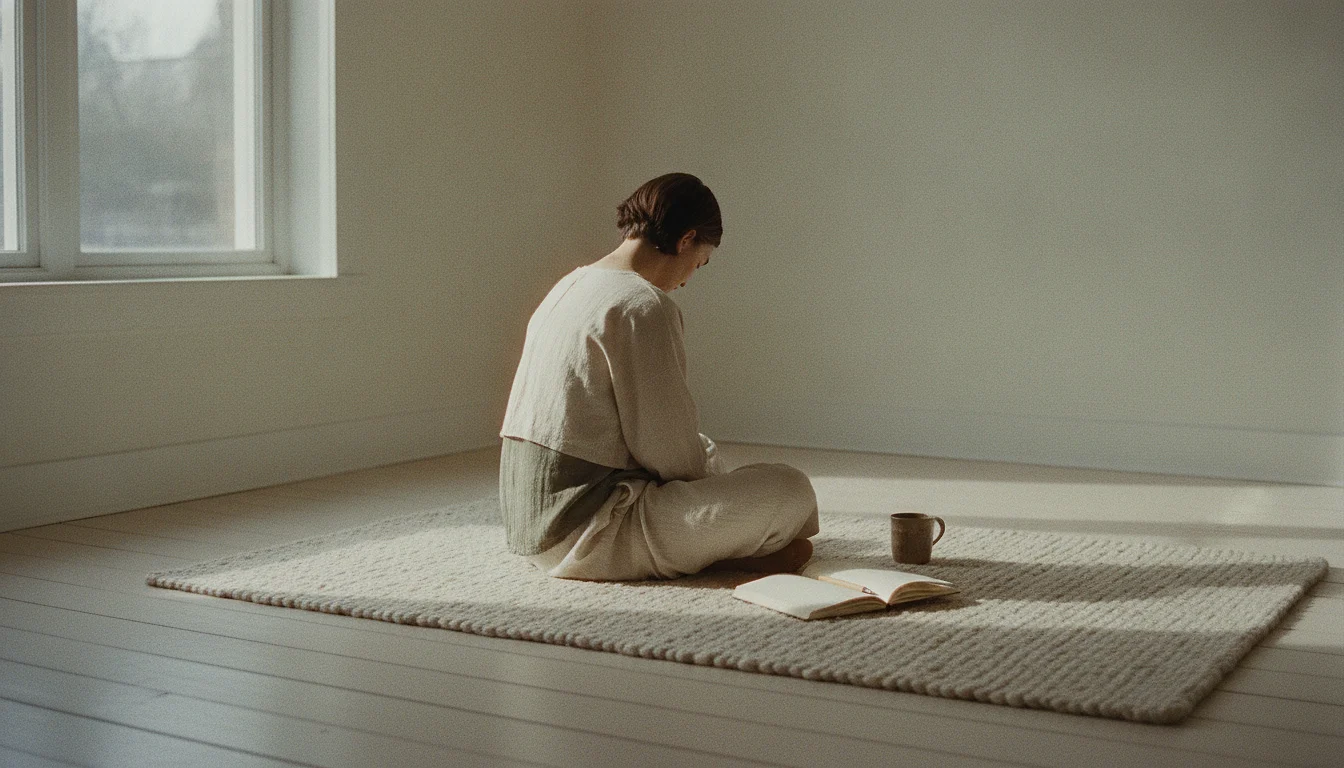
Search for mindfulness for anxious attachment and the results arrive as instructions: sit like this, breathe like that, write these prompts. This page does the opposite. It describes what each practice is structurally working on inside the pattern, what it leaves untouched, and where the descriptions stop being honest. Mindfulness for anxious attachment is, in that reading, the habit of separating a signal from the story built on top of it, before the story turns into a message.
Why do these practices come up around anxious attachment?
Because the anxious pattern is fast, and all three practices are ways of putting something between the signal and the action. A reply is late, a reading forms, a message gets drafted — and the whole sequence can finish before anything has been decided. Practices that create a delay are attractive for a mechanical reason, not a spiritual one.
The pattern itself is described in detail on the triggers page: a change in availability arrives, the system reads it as information about the bond, and an action follows to close the distance. Mindfulness, journaling and meditation each land at a different point on that line.
There is a second reason they cluster around this topic. The advice that surrounds this topic is behavioural — wait before replying, seem busier, need less. That advice asks a person to fake the outside while the inside stays exactly as loud. Calming practices at least address the loudness rather than the performance.
What does mindfulness do with the pattern?
It separates the event from the reading. In practice, that is small and unimpressive: the timestamp is a timestamp, and “he has lost interest” is a sentence the alarm produced about the timestamp. Mindfulness is the habit of noticing that a second thing happened after the first thing, and that the second thing is not evidence.
The pattern’s speed is what makes this matter. When the reading arrives fused to the event, it does not feel like an interpretation; it feels like finding out. Anything that unglues the two for a moment gives the interval described on the self-soothing page somewhere to exist.
The practice is closer to labelling than to serenity. For example, naming that the chest went tight, naming that the phone is in hand again, naming that a story has started and has already picked its ending. None of this feels calm while it happens, and expecting calm from it is the first place the practice gets misrepresented.
One limit deserves precision. It does not answer the question the alarm asked. If a partner has actually gone distant, observing the thought does not settle that; the relationship question stays open, and it is a different kind of question from the pattern question.
What is journaling doing here?
Journaling is the practice that works after the moment rather than inside it. Its function is recording: what happened, what the alarm claimed was happening, what got sent, what came back. On paper a spiral has a shape — the same trigger, the same escalation, the same relief when contact resumes, the same embarrassment afterwards.
That shape is invisible from inside a single episode. Every spike presents itself as being about this specific evening and this specific person. A page of them written down in plain language turns a series of emergencies into something with a recognisable structure, which is the only sense in which journaling for anxious attachment does anything the person could not do in their head.
The interpretive version — for instance, pages of why, childhood reconstruction, verdicts about a partner delivered in writing — is the one that stops being useful, because the pattern is already fluent in interpretation. Producing another explanation of yourself at midnight is the spiral continuing in a nicer format. Recording is duller. It is also the part that survives being reread later, when the evening it describes has stopped being urgent.
Two things are worth writing down and easy to skip. What the alarm predicted would happen, and what happened. Kept side by side without commentary, those two columns are the closest thing to feedback the pattern ever gets. The prediction arrives with total confidence attached and turns out on paper to have been a sentence rather than a forecast, and reading that in your own handwriting is a different experience from being told it.
The form matters less than the fact of the record. A dated line in a notes app does the job that a leather notebook and a set of prompts also do. What breaks the function is turning the record into a performance: writing for a version of yourself who will read it later and be impressed, or writing to build a case about a partner that can be produced as evidence. Both turn a log into an argument, and the pattern does not need help arguing.
There is a limit worth stating. A record shows the shape of the pattern; it does not show what is happening in the relationship the pattern is reacting to. Those two questions look identical at the time and they are not the same question, and a journal cannot separate them for you.
What about meditation?
Meditation is the practice that sits furthest from the trigger. It is not aimed at a specific spike; it is practice at staying with an internal state without immediately doing something about it, which is the exact capacity the anxious pattern skips.
Sitting with an activated attachment system is not restful. The urge to check the phone arrives, and there is nowhere for it to go, and that is the material rather than an obstacle. This is the practice where the urge becomes most obviously an urge rather than a fact: it shows up, insists it is about something, is not acted on, and changes anyway.
That last part is the whole content of it. Inside the pattern, an urge and its execution are one event; the message is halfway written before anything has been decided. Sitting still with an urge that does not get executed is the same event pulled apart into two, and the pulling apart is the practice. Nothing is being calmed down. Something is being separated.
This is also where the practice gets mis-sold. Sitting is described as the part of the work that produces peace, and the honest description is closer to the opposite: it is where the noise becomes audible, because nothing else is competing with it. A session that felt loud and uncomfortable is not a failed one, and a session that felt pleasant is not evidence of progress on anything in particular.
The honest caveat is about generalisation. Consider a Friday night when a message has gone unanswered for hours: being able to sit with discomfort in a quiet room does not automatically transfer there. Whether it transfers, and how much, is not something this page can tell you, and the sources that promise the transfer are promising something they have not measured on you.
Meditation for anxious attachment also carries a specific misuse: sitting instead of speaking. Using the practice to suppress a need until it stops being inconvenient loads the spring rather than releasing it, and the loaded version comes out later as protest behavior. What the healing hub describes is a change in timing, not a change in whether needs get voiced.
What can these practices not do?
The practices are described here as mechanisms, not as remedies, and the difference matters enough to make it explicit. Set side by side, they differ mainly in where on the sequence they land — and they are identical in what they leave alone.
| Practice | Where it intervenes | What it does not do |
|---|---|---|
| Mindfulness | Inside the moment: between the event and the reading built on it | Answer the question the alarm asked, or say whether the reading is right |
| Journaling | After the moment: a record of what was predicted and what happened | Change anything while the wave is running, or settle a relationship question |
| Meditation | Outside the moment: practice at holding a state without acting on it | Transfer to a live spike on any schedule, or make the urge smaller |
What this page won't do
Calming-practice pages have four standard moves. This one declines all of them.
- Claim effectiveness
- There is no statement here about how well any of these practices works, for anxious attachment or anything else. Approved figures do not exist for this claim, so the claim does not get made.
- Hand you a protocol
- No durations, no counted breathing patterns, no number of sessions per week. A practice described with a stopwatch becomes another thing to do correctly, and doing things correctly is not what is short in this pattern.
- Recommend apps, courses or teachers
- Naming a service in this territory is a recommendation this site is not in a position to check, so none appear.
- Promise the feeling stops
- Nothing here suggests the spike gets smaller, or that closeness stops mattering. The need for closeness is not the problem being worked on. The gap before acting on it is.
One more limit belongs in the open. None of these practices resolves an actual relationship question. If a partner is genuinely unavailable, a settled nervous system reads that situation more clearly rather than making it acceptable. The practices work on the reading, not on the facts being read.
Where this page stops
This page describes practices people mention alongside an attachment pattern; it cannot tell you whether any of them will help you, what is happening in your relationship, or whether what you are experiencing is this pattern rather than something else. An attachment pattern is a descriptive framework, not a diagnosis, and nothing here distinguishes it from clinical conditions that can look similar from the inside. If the spikes described above are shaping your sleep, your work or your sense of safety, that is a question for a therapist or a doctor, who can ask what a page cannot.
A short note when we publish something new on this
No spam, ever. Unsubscribe anytime.