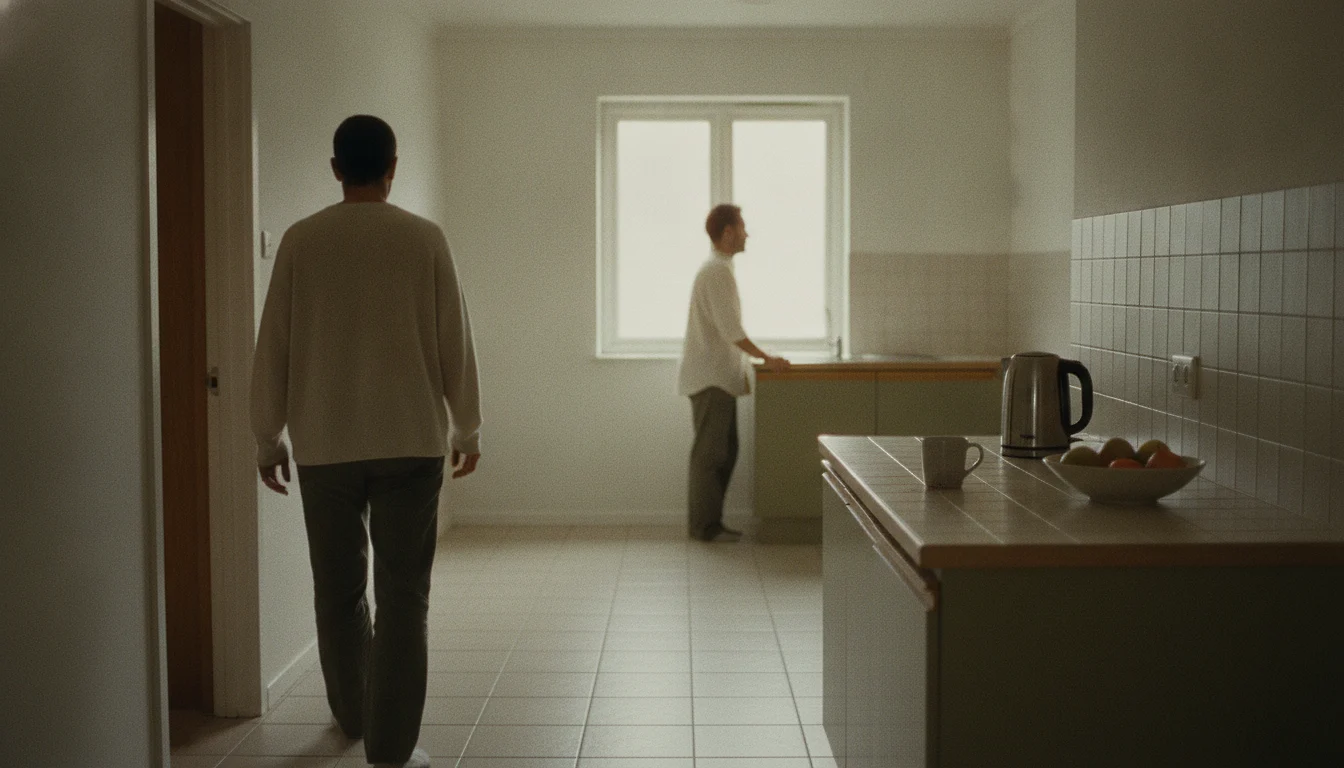
The anxious avoidant trap is easier to recognise than it is to leave: two people whose ways of calming down happen to be each other’s trigger. This page walks the loop from the anxious chair, step by step, and is explicit about the part it does not attempt — what is going on in the chair opposite.
What is the anxious-avoidant trap?
The anxious avoidant trap is a loop between two people whose ways of feeling safe cancel each other out. One partner moves toward closeness when the ground feels unsteady. The other takes space for the same reason. Pursuit arrives as pressure, so the space widens. The widening arrives as abandonment, so the pursuit intensifies. Each person’s method of calming down is the exact input that sets the other one off.
The word trap earns its place because nothing in the loop requires bad intent, poor character or a fight worth having. Both moves are attempts at safety. Both are delivered to someone for whom that particular attempt means danger. That is why the cycle survives apologies, good weeks, honest conversations and genuine love between the two people running it.
This page is written from the anxious chair, because that is the chair the search for an explanation is being made from. The withdrawing side gets equal weight in the description of the loop, and no weight at all in speculation about its inner life. What happens inside another person is not something an article can report.
How does the cycle run, step by step?
The cycle has a recognisable order, and it runs the same way whether the interval is an evening or a month. Closeness rises. One person needs room and takes it. The explanation may or may not come. The other reads the room as the beginning of an ending and closes the gap. The gap gets closed harder than it was opened, so more room gets taken. Then comes a truce that neither person names, and the next round starts from a lower threshold.
The truce is the part that gets skipped in descriptions of the loop, and it is the part that keeps the loop alive. For example, contact resumes, the tone softens, and nobody says what happened, because saying it risks starting it again. Unspoken truces feel like resolution while leaving the whole mechanism in place, which is why the same evening can repeat for years with different details.
| What happens | How it reads from the anxious chair | What the loop does with it |
|---|---|---|
| Closeness rises after a good stretch | Confirmation the bond is solid | The next change in tone has further to fall |
| One partner takes space | Something has changed and nobody said what | The gap gets closed harder than it was opened |
| Contact increases: messages, calls, questions | Reaching, and asking to be reassured | Intensity rises on the one channel still open |
| The space widens instead of closing | The feared thing beginning | The reaching speeds up to match |
| The ask becomes an ultimatum or a test | A demand for something definite, at last | The definite answer does not arrive; the ask is what stays in the room |
| Contact resumes without a conversation | Relief that it is over | Nothing is named, so nothing is changed |
| The next trigger arrives sooner | Proof it was never actually settled | The threshold for the next round is lower |
Read the middle column down the page and the loop stops looking like a conflict about a subject. It looks like a chain of readings, each one plausible from the chair it is made in, each one producing the next move. The messages are not being misheard. They are being delivered in a format that lands as something other than what was sent.
Is the pursue-withdraw cycle the same thing?
Largely, yes, in different vocabularies. Pursue-withdraw describes what an outside observer sees: one person raising contact, the other lowering it, both convinced the subject is dishes or plans or a tone of voice. The anxious-avoidant framing reads the same motion through the vocabulary of an open-access review of adult attachment, where the behaviour is about distance rather than about the stated topic.
The practical difference is what each name suggests doing. Pursue-withdraw invites a fairness question: who started it, who is being unreasonable. The attachment framing makes that question uninteresting, because both moves are answers to the same uncertainty. Whether the argument was won stops mattering when the argument was never the subject.
What does the loop feel like from the anxious side?
It feels like watching something disappear in slow motion while being told nothing is happening. The signals are small and constant: a reply that takes longer, a shorter message, a plan that moves. Each one is minor enough that mentioning it feels unreasonable, and the accumulation is loud enough that not mentioning it becomes impossible.
There is a specific exhaustion in this position, and it goes unnamed. In this position, the tracking of the relationship’s state is being done from one chair. Noticing the shift, deciding whether to raise it, choosing the wording, timing the send, then managing the aftermath alone. Being called too much by someone who is not tracking anything is a particular kind of tired.
What the system does with the small signals is not neutral observation. It builds the story forward — where this ends, what it will mean, how it was always going to go — and the story raises the stakes fast enough that acting on it feels like the only option left. The moves that follow have a name and a mechanism of their own: protest behavior covers what they are trying to do and why they land the way they do.
What does the withdrawing side actually do?
Equal weight here means equal description, not invented interiority. What is observable is this: contact drops, replies get shorter, plans get vaguer, and the topic that was raised does not get closed. The withdrawal is not announced, which is the detail that makes it unbearable to the person watching it happen.
What can also be said is structural. Space taken under pressure is taken further than it would have been otherwise, and it arrives without notice, because announcing it would restart the conversation it was taken to end. That is a description of how the loop moves, not an account of anyone’s reasoning.
Anything past that point — motives, whether the person is aware of it, what they feel about the relationship, whether they come back — is not on this page and cannot be inferred from behaviour seen from one side. The comparison of the two patterns, at the level the comparison can honestly go, sits on the anxious and avoidant hub.
Why doesn’t trying harder fix it?
Because effort inside the loop is delivered as intensity, and intensity is the input the cycle amplifies. For example, three more messages, a longer explanation, an insistence on settling it tonight: each is a real attempt to repair, and each raises exactly the pressure the other side is already stepping away from. The effort is genuine and the direction is wrong.
The second reason is that relief obtained by pressure does not hold. Consider a reassurance extracted at midnight: it is answered by the fact of its extraction — the system knows how it was obtained, so it expires by morning and the threshold for the next round is lower than it was. That is why a good conversation inside this loop can change nothing.
The third reason is the least comfortable. A loop needs both halves, and only one half is ever available to any one person. No amount of effort applied to someone else’s half is effort applied to the loop. This is the point where advice about how to make an avoidant partner respond becomes a way of staying inside the cycle while feeling productive.
How do you break the anxious-avoidant trap?
Not by winning the round. What changes the cycle from the anxious side is the gap between the trigger and the move — long enough to notice the urge as an urge, long enough for the spike in the body to come down, long enough that what happens next is chosen rather than launched. The gap starts short. Short still breaks the sequence, because the sequence depends on speed.
Inside the gap, one substitution does the work: a direct statement instead of a move. The quiet since Tuesday has been sitting with me and I would rather say that than keep guessing carries the actual content, and it is harder to say than sending three messages, because it admits to needing something. That exposure is what the loop’s moves exist to avoid.
The second thing that changes it is naming the cycle rather than the person. For instance, there is a difference between you always shut down and we do a thing where I come closer and you need room, and it speeds up every time. The first names a defendant and produces a defence. The second names a shape both people can look at from the same side of the table.
The physical half of the pause has its own page: self-soothing for anxious attachment covers what to do while the gap is still uncomfortable. How the pattern behaves across other relationship situations is mapped on the relationships hub.
None of this is a method for keeping a particular relationship. It changes what one person contributes to a loop, and that is the honest size of the claim. What the other half of the loop does in response is not something an article can predict.
What this page does not do
The trap is a describable dynamic. That description has limits, and they are worth being explicit about.
- No account of the avoidant partner's inner life
- Motives, feelings, whether they are aware of the cycle, whether they come back — none of it is knowable from behaviour observed from one chair, and none of it is guessed at here.
- No verdict on the relationship
- Nothing here says leave, and nothing here says stay. A page cannot know a reader's relationship, and a description of a pattern is not grounds for a decision about a person.
- No tactics for producing a reaction
- Withholding contact to be missed, matching someone's silence, or engineering distance to reset the balance are not described here as techniques. They are moves inside the loop, not exits from it.
- No numbers about people or timelines
- This site publishes no figure it cannot trace to a named, dated source, so there is no count of stages, no share of couples and no estimate of how long any of this takes.
Where this page stops
This page describes a dynamic between two people and what each move lands as; it cannot tell any particular reader whether their relationship is running this loop, whose half is which, or what will happen if something changes. An attachment pattern is a descriptive frame from a research tradition rather than a diagnosis, and nothing written here distinguishes it from clinical conditions that can look similar from outside. Where a couple is stuck in the cycle and cannot describe it to each other, that is work for a couples professional; where the fear underneath is shaping daily life, or where anyone in the relationship feels unsafe, that is a conversation for a therapist or a doctor rather than for an article.
A short note when we publish something new on this
No spam, ever. Unsubscribe anytime.